
$0.00

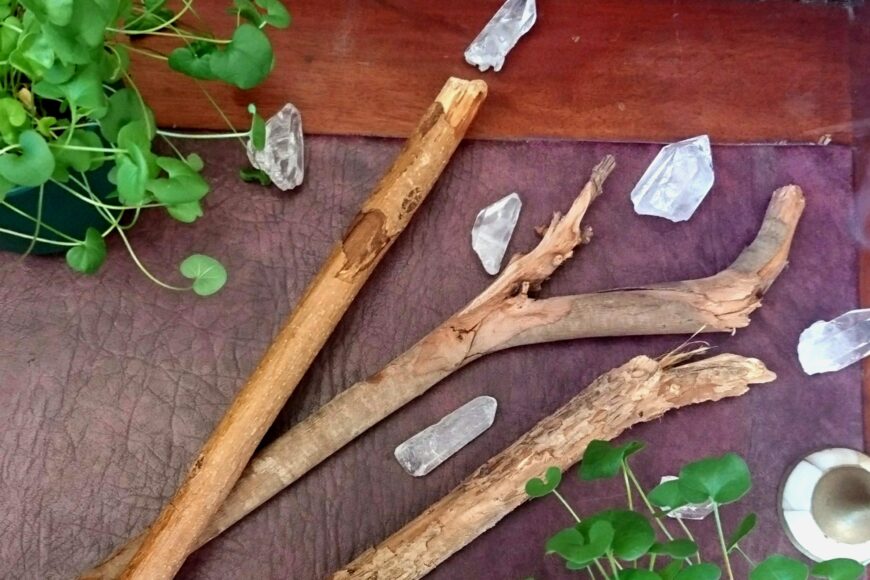

An overthinker’s guide: Wands.
During my crisis of faith, I’ve been meditating on each of a witch’s tools and really thinking about if I connect to them. What are their histories? Their traditional uses? If Wicca stole them, where were they stolen from?
Each tool has a purpose, some purposes cross over, and some seem pointless. For example, the boline. In Wicca, a witch is supposed to have a sickle with a white handle, called a boline, for harvesting herbs. It’s the “feminine” counterpart to the athame, because girls cook and boys kill… or command. Whatever. But in the rare event I can’t harvest a plant with my fingers (looking at you rosemary) a pair of scissors does a mighty fine job. They’re also less illegal to have in my backpack if I’m out in the wild, and I can use them for other things, like gift wrapping. A moon-shaped blade looks cool, but for a modern witch? Yeah not really practical.
Today, I’m looking at the wand. I haven’t had a wand in a fucking decade, so you’d think it’s not all that necessary and I could just pass. But, I have missed my wand that whole time. The only reason I stopped using a wand was because I couldn’t take my old one to Canada (untreated wood, super delicate and super long) so I pulled it apart. I always intended to remake it, but I didn’t connect to the land in Canada, and when we moved home I popped out babies like nobody’s business. It’s only now that I have not only the time but the mental capacity for my craft and BOOM crisis of faith. Joy.
Plus, my old wand was a “Native American Insipired” culturally appropriative mess that was absolutely covered in dead animal parts. That’s not my jam now. But before I put the time, effort, and money into another wand (I found my wood years ago) I want to make sure I’m getting the symbolism right.
Anyway, here’s a fascinating fact: One key inspiration for wands was the Jewish Yad, a pointer used while reading the Torah (The parchment is made from Vellum – animal skin – and doesn’t hold ink all that well, so touching it is a big no-no). In part this is awesome. I had a Jewish grandmother (ethnically not religiously) so I love that connection back to the family I never knew. But the connection here is rooted in anti-Semitism. The caricature of the witch and her wand is said to have been used against Jewish people.

Right: The yad has a strong similarity to a wand.
Of course, wands or “rods” feature in Homer’s The Iliad and The Odyssey too, as well as in seiðr (old Norse magic).
Those “witches” were called Völva which translates to “wand carrier” and they often used a wand/staff to perform their rituals. We can’t say for sure if length and material varied because Christians destroyed a lot of the documentation, but one was found in the grave of a Völva that was over 2ft long. Sceptres have also had their place throughout history as items of power and shouldn’t be discounted.
Here’s a wiki on witches hats too, seeming they appear in the anti-Semitic image to the right: https://en.wikipedia.org/wiki/Witch_hat
Definitely not the representation of a “cone of power” that Wicca likes to spin it as. (Or a vaginal symbol. I’ve heard that theory too.) Personally, I’ve never seen the hat in a spiritual light. They’ve always said “Hollywood witch” to me. So, no loss there.
Edited to add: I just finished watching this video on the black witch hat. It’s well worth your time.
As far as wands go, I’ve always been drawn to a much longer wand than the Wiccan standard “as long as your forearm to your fingertip” and though I would never want to mock or harm Jewish people in any way, I like that the Yad is tied to learning and communication, because so is the wand. So I’m putting a wand in the “keep” pile, at least for now.
Additional wand info:
Wands can be made of many different things. I believe some found in graves were iron, and that might be desirable to keep the fae away. Crystal wands are hugely popular at the moment.
But to me, a wand is the tool of air/gas. (I do need to put more research into where this idea came from, I admit.) Whilst most of the oxygen on earth comes from phytoplankton in the ocean, trees do give us trace amounts of oxygen too. Trees are also what we most commonly make paper from and paper = learning and communication. So I always make my wands from wood. (Yeah, there’s a big ol’ web in my brain. All my thoughts are this messy, it’s a wonder I function at all.)
Crystals, too, are associated with air, but I don’t actually know why. You’ll see infographics with “cosmic witch” and it’s always astrology/air/crystals. Is it because they sparkle like stars? Is it because some rocks are from space shit that crashes here? The invisible vibrations? I don’t know.
Crystals have been proven to direct energy – they can be made to vibrate with a precise frequency, such as quartz in wristwatches. So it makes sense to include crystals in the design of a wand, if not to make the whole thing out of rock. This leads me to a wand’s uses.
Wands put me in mind of “talking sticks”—whoever holds the stick talks, and everyone else listens—but it occurs to me now that the concept of talking sticks was probably also taken from somewhere, and I need to respect that. Never the less, the symbology of communication continues.
Early on, I was taught that a wand is for “asking” and an athame is for “commanding”. So, if you’re directing lesser spirits like elementals, you do so with an athame so you can control them. But if you’re working with a god, you ask politely and point where they need to go with your very respectful stick. The logic here is shakey, I know.
Later I was doing some group work and I learned that the athame isn’t always used for directing power, and that changed the way I saw the wand. If the athame is for cutting things we can’t see (like the veils between worlds) then it makes more sense that there’s a dedicated tool for directing power. And I like that a whole lot more than the wands “ask nicely” theory.
As I don’t have a wand, I do still use my athame, or my hand, for everything. I draw the circle with it, charge objects with it, dip it in the wine for Cakes and Ale, as well as cutting invisible things. And my magick still works. So, I’m not saying it’s wrong to have a metal or crystal or glass wand, or to not use one at all. Witchcraft is a poor person’s science, we experiment and keep what works. I’m just saying I like a good stick when I can get one! (Hehe stick)

Miriam Cumming is a mum, wife, witch, and author, currently focused on YA fantasy. To read her free novella, Celtic Dreamer, and join her freaking amazing newsletter, click here.
Celtic Dreamer
For thirteen-year-old witch Morrigan, morality is simple. She’s unapologetically vegan and makes memes to prove it. Witchcraft is another form of activism for Morrigan, whose recent mastery of astral travel enables her to leave her body while she sleeps. But when an outbreak of SUNDS—Sudden Unexplained Nocturnal Death Syndrome—hits Australia, she finds herself slipping into the dreams of the killer.
As a vulnerable younger witch becomes a target, Morrigan is obligated to act. Except she might discover she’s more aligned with the killer than the victims.