$0.00

Don’t simp in the comments
The evolution of language.
Language is a funny thing. Most of the time we aim to get the message across in as few words as possible, the goal being to communicate effectively. Language also evolves. Every word was made up at some point, and new words are being made all the time, particularly as new technology is developed. Social media is a breeding ground for the evolution of language too – people try to pack as munch meaning into their character limits as possible. We’re also finding new uses for long established words, and re-purposing nouns to become verbs, like:
“I don’t want to adult today.” And “The math isn’t mathing.”
This process is called denominalization, or “verbing”.
Our careers come with jargon. Our hobbies and fandoms come with their own unique words and phrases.
Why, then, do people push back so hard against inclusive language?
It’s more effort to write “he/she” than to use they.
Why write “brothers and sisters” when the word siblings exists?
That’s not to say inclusive language is always simpler, it’s not. It’s much easier to say “women” than “people who menstruate.” Even though a lot of women can’t or don’t menstruate, and many of the people who do menstruate aren’t women. Teen girls, for example. In this case “women” might be easier, but it’s also less correct. Perhaps inclusive language is confronting for people because it’s more honest?
Woe betide us if we talked about natural bodily functions and parts without shame!
Inclusive language is a challenge to think outside of our own experiences and the things society has programmed us to think of as default. Of course, those same structural biases have taught us to give less respect minorities. And it can be easy to dismiss the need for inclusive language because it’s easy to dismiss people we see as lesser than ourselves. These people include but aren’t limited to: Indigenous people, disabled people, immigrants, women, and queers.
Yet we brush off our lack of inclusive language with a chuckle and a “you know what I mean.”
Most of the time, yeah, I can determine from context that you mean “people with vulvas” when you say “women.” But sometimes “women only” means “everyone who’s not a cis man” and sometimes it means “only cis women.” If I get that wrong, it could be unsafe for me, or I could be intruding on space I don’t belong in, making others feel unsafe.
Of course, no discussion of inclusive language is complete without pronouns – people love to argue about that shit, even when half of them don’t know what a pronoun is or what role it plays in language.
Using inclusive language can mean not assuming people’s personal pronouns. That can mean asking people for their pronouns when meeting them, or using singular they as default until you confirm their gender. I’m not particularly fussed on this, I can take it or leave it. But the mere suggestion of doing these things really upsets some people, and I want to look at that.
Arguments I’ve heard in person include “we should be able to call people whatever they look like” and “It’s stupid to try and control the descriptions other people use for you” and “it’s too hard.”
Listen, I get that there’s a program in our brains automatically ticking a pink or blue box when we interact with someone, and from that the easiest route is using the pronouns that match our unconscious assumption. But it’s also true that we can re-write our brain’s programs. We can form new neural pathways. We can learn – no matter how old we are. We can add more coloured boxes for our brains to tick, and if need be, we can practice a person’s pronouns until they feel right and natural.
Should we be able to call people whatever they look like? The short answer is: we already do. And sometimes that’s fine. Positive even. Sometimes it’s rude. You might look like you fell out the back of a garbage truck today, but should I call you a dumpster gremlin? Maybe not. If you think a trans woman looks like a dude, you can call her a he, no one will stop you.
Is it stupid to try and control how people see and speak about us? Maybe. We can’t control other people, we can only control our own actions. With that said, think about the language people use for you. Have you ever worked with a person who called you “bro” all the time, and you were like “We’re not related. We’re not even friends. Please stop.”? Ever had a nickname you despised? Ever been given a compliment that made you feel gross instead of uplifted?
Are you saying you don’t have a preference at all about how people describe you? You’re equally okay with being called soft, weak, or handsome, as you are strong, pretty, or prudish? There’s no difference between being called curvy and being called fat? Doesn’t saying “his face is rugged” have a nicer connotation than “rough” or “uneven”?
The truth is: everyone has things they want to be perceived as, things that bring them joy or discontent. Everyone experiences gender dysphoria from time to time. But the only time we think it’s stupid, laughable, or too hard to deal with, is when it’s happening to a trans person – because we respect trans people less.
Is it too hard? Well, I can’t tell you what you’re capable of. What I can say is that singular they has been around since the 13th century and you’ve used it your whole life. Singular they is older than singular you (yes “you” is also a pronoun.) Plus, you have trained yourself to think differently about people before: when people marry, you remember to use their new last name or title. You remember to refer to their spouse as husband or wife rather than girlfriend or boyfriend.
You might have a friend that you interact with in multiple places, and you can remember to call them Cantos while playing D&D, Rohan while playing Halo, Daddy in the bedroom, and Barry at the pub. Yet when your friend Micha wants to change their legal name to Mike, it’s suddenly too hard?
If you can adopt words like “simp” and “yeet” (or whatever is currently new and hot, stolen from AAVE) or inject lines from your favourite movies into your lexicon (Muggles, anyone?) you can learn to use inclusive language. Look right now at your vocabulary; you don’t have a single word or phrase that you use which you’ve picked up from one of your hobbies or special interest communities? None? Really?
Here are some of mine:
I rolled a one
I’m out of spoons
Fed two birds with one scone
It doesn’t take much to make a cloud happy
Natural twenty
Ninja fingers
Weekly spread
Broke my suspension of disbelief.
DNF
Deadname
Booblesnoot
Spooniecorn
I lost the game
There are probably hundreds more. I guarantee that you have language you use specifically around your family, in your workplace, and with your different friend groups. If you’re consuming any kind of media, you are picking up new ways to use words all the time.
So if we’re being honest, no, it’s not hard at all. It’s not new. It’s not “stupid.” It’s purely human. The nature of language and society is to evolve.
What’s your favourite new or niche word you wish would catch on?
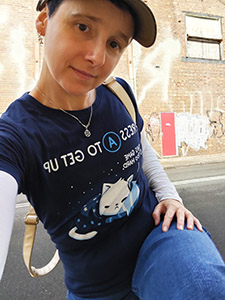
Miriam Cumming is an author, parent, spouse, and practising witch. When ze’s not nerding out over words, you can find hir drinking coffee and building lego.
If you want to listen to Miriam talk about trans stuff, look for hir on Tiktok, if you’re more into witchcraft and planning, you’ll enjoy hir Instagram. Lastly, if you like all that plus free books and exclusive content, Miriam has a banging fortnightly newsletter you can sign up for here.
spoonicorn and ninja fingers are my fav.! x